Florence Pugh shines in Olivia Wilde’s slick psychological thriller that prioritises showing and not telling.
****
The elephant in the room recently has been the backstage ‘drama’ – yuck – of Olivia Wilde’s second directorial effort Don’t Worry Darling. But that is, ultimately, completely irrelevant when it comes to discussing the film itself. And, despite what some on the internet might have you believe, it’s a good film. A psychological thriller that doesn’t particularly deliver the answers to the questions it asks, but looks bloody great and offers a stunning lead performance from Florence Pugh.
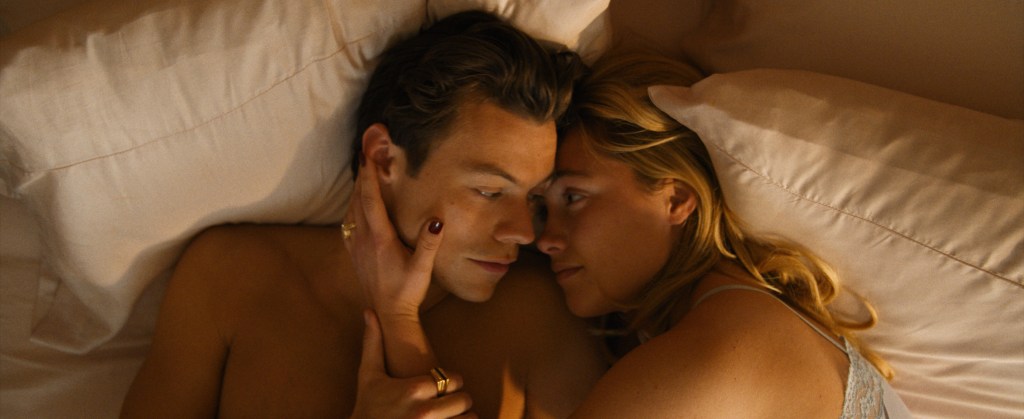
Victory is an isolated but idyllic sun-drenched town, where the husbands drive off to work each morning in perfect synchronicity and their wives wave brightly from the perfectly manicured lawns of their perfectly manicured ‘50s houses. Alice (Florence Pugh) and Jack (Harry Styles) are one such pair, unable to keep their hands off each other and relishing in their child-free, honeymoon-stage marital bliss. But when Alice sees a plane crash into the mountains, she starts having visions and asking questions about what exactly Jack does all day when he’s out working for the town’s enigmatic founder Frank (Chris Pine). And then she starts to wonder if life in Victory really is as perfect as it may appear.
Don’t Worry Darling relishes in its set up, hammering home the point that Victory is the utopian company town it advertises itself as. A great place to live, safe from the dangers of the desert surrounding it and full of perfect couples. The opening montages of Alice’s daily routine – cleaning, cooking, shopping, dance classes, sex on the dining room table when Jack gets home from work – establish a perfect housewife existence. The neighbours are all friendly, the houses are all stunningly decorated, and the flow of liquor is seemingly never ending. And it’s in exploring that ‘perfection’ that Wilde really shines. The film piles on the intrigue, the questions and the mystery; it explores interesting ideas and visualises themes like isolation and domestic suffocation by having the walls literally close in on Alice as she scrubs them clean. But then it… doesn’t really do anything satisfying with them.
The film edges closer and closer to an answer, an explanation, and then seems to chicken out at the last minute. The twist is frustratingly vague and underexplored, particularly when aspects of it feel really relevant and would have allowed the ardently feminist Wilde to make a bold statement about the idea of a woman’s ‘role’, instead of just hinting at it. The film tiptoes around exploring the consequences particular thinking has on society, on the way in which we can be indoctrinated by incel thinking and the problematic nature of a woman belonging to a man, and keeps its focus narrowed to Alice and Jack. And while this isn’t necessarily a bad thing, it makes for a much less interesting second half, when the first was so intriguing and well-crafted.

Pugh as Alice is by far the film’s standout performance. She’s so charismatic and fearless in front of the camera, bold in her choices, and even as a perfectly coiffed, docile housewife, there’s an edge to the character that Pugh sells brilliantly. As her counterpart, Styles’ Jack is a bit blander and less compelling. Styles certainly looks the part, but his acting is still not convincingly ‘movie star’ quality. The rest of the cast are all perfectly fine, but there’s very little development to anyone other than Alice. KiKi Lane as Margaret, the first of Victory’s women to question ‘reality’, is frustratingly underused, as is Gemma Chan as Frank’s wife Shelley. Wilde also stars as Bunny, Alice’s closest friend, and gets a few emotional beats that don’t land as well as they should; not because of Wilde’s performance – which is great – but because they come right in the midst of the lacklustre final explanation and so lose their impact.
It’s a decent script from Katie Silberman – who collaborated with Wilde on her directorial debut Booksmart – and Carey and Shane Van Dyke, but it feels so oversaturated with inspiration and ideas, that it loses its way once it strays from its set up. Chris Pine is menacingly charming with what he’s given; reminiscent of the cliché, vapid ‘nothingness’ often associated with the self-help gurus and lifestyle influencers who really don’t have the qualifications to tell you how to run you your life, combined with the dangerously persuasive men who hate women that are terrifyingly present online. It’s clever but unexplored, much like Frank himself, and it’s a recurring theme throughout the whole film.
But thematic and narrative quibbles aside, Don’t Worry Darling is stunning stylistically. The music is top tier, the costuming from Arianne Phillips is so effective, Katie Byron’s production design delivers ‘house goals’ for days, and the cinematography from Matthew Libatique is so expressive and interesting. It’s a film that emphasises its director’s vision, even the oft-discussed sex scenes are delivered as fantasy for the man framed via the woman, and that feels emblematic of what Wilde is hoping to achieve with the film.
Ignoring the discourse and speculation – because that’s what it is, for the most part, pure speculation– about what may or may not have happened behind the scenes, Don’t Worry Darling is a film from a director who has a unique and distinct voice and is not afraid to take risks, even if it doesn’t lead to the conclusions we may want. It’s a bold piece of filmmaking from a woman who deserves to have her work talked about, rather than her private life, and who deserves a bit more of our respect. Go see it and make up your own mind, judge Don’t Worry Darling on its cinematic merit and not tabloid fodder.
 trampologywrites
Leave a comment